Why one corner of your lawn stays brown when the rest is fine
The most common irrigation call we get in Merritt Island has almost nothing to do with the pump.
September 17, 2026 · 4 min read
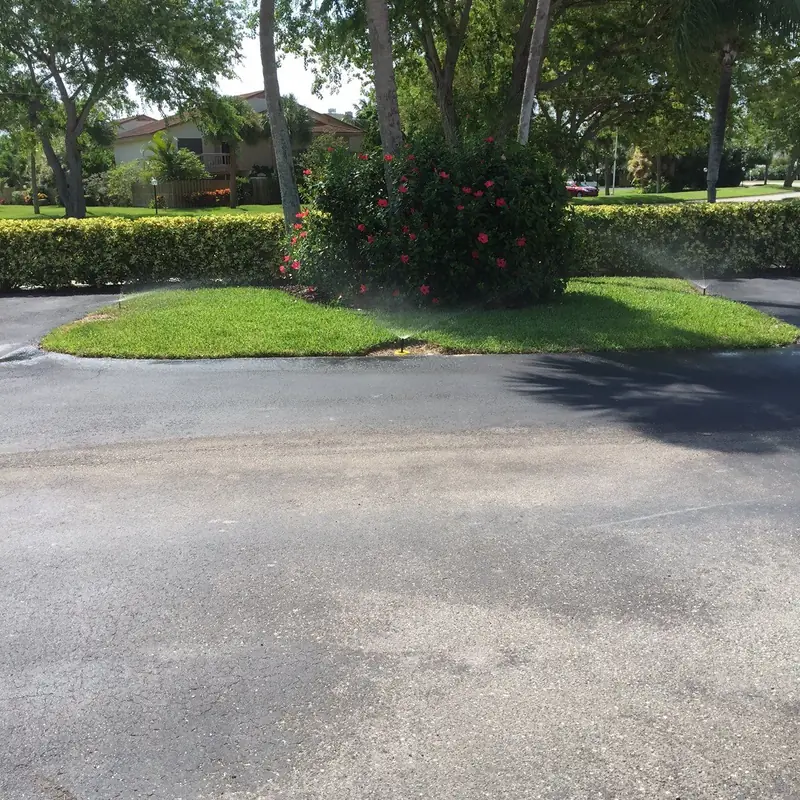
It starts small. One corner of the lawn goes a shade paler than the rest, usually along a drive or a fence line, and it shows up first in the dry months. The obvious move is to run the system longer. That is also the move that turns a small problem into a large water bill, because the part of the lawn that was already getting plenty is now getting far too much and the pale corner is still pale.
Sprinklers are specified to reach each other
Every sprinkler head, rotor or spray, has a throw distance it is designed for. A proper layout puts the next head at roughly that distance, so the edge of one arc lands on top of the next head rather than stopping short of it. Contractors call this head to head coverage, and on paper it looks like enormous overkill: the ground halfway between two heads gets watered twice.
It is not overkill. A sprinkler does not deliver water evenly across its arc. It throws far more close to the head than it does at the outside edge, where the droplets are finest and the wind gets at them first. Overlapping two of those thin outer edges is what produces an even result on the ground. Space the heads so the arcs merely touch and you have built a system whose weakest coverage is exactly where the two arcs meet.
How to see it without any tools
Run one zone in the early morning when there is no wind and stand where you can see the whole zone. Watch where the water is actually landing rather than where the heads are pointing. If you can see a band of drier ground between two heads while both are running, that is the answer.
The second check is even simpler. Look at the shape of the brown. Coverage gaps make crescents and bands with soft edges, following the geometry of the arcs. Root problems, chinch bug damage and fungus make blotches that do not line up with anything. If the pale area has a curve to it that matches a sprinkler arc, it is a layout problem.
The things that make a good layout go bad
- A head that has settled. Over a decade a pop up can sink half an inch into soft ground, which is enough to put the spray into the grass instead of over it.
- A worn nozzle. Grit in the water slowly opens the orifice, the pattern goes ragged and the throw shortens. The zone still runs, so nothing looks wrong at the controller.
- A head knocked round by a mower or a car. Now the arc is pointing at the driveway and the corner it used to cover gets nothing.
- Planting that grew. A shrub that was knee high when the system went in is now intercepting the spray.
- Pressure lost somewhere upstream, usually a small leak on a lateral, which shortens every throw on that zone at once.
That last one is worth separating out, because it is the only item on the list that genuinely is a pressure problem, and it announces itself differently: every head on the zone throws short, not just the ones near the dry corner.
Why adding more time is the wrong lever
Irrigation timers control duration. They do not control where water lands. If a patch of ground is receiving a third of what its neighbour receives, doubling the run time means that patch now receives two thirds of what its neighbour receives at double the cost, and the neighbour is being drowned. Soggy turf in Florida heat brings its own set of problems, most of them fungal.
The fix is mechanical and it is usually cheap. Reset the arcs that have been knocked round, raise the heads that have settled, swap the nozzles that are worn, and if there is a genuine spacing gap in the original design, add a head. Adding one head to an existing lateral is a small job.
Why it is worth catching early
St Augustine and zoysia both recover from underwatering if it is caught in the first season. Left for two or three years, the pale area stops being a watering problem and becomes a replanting problem, because the turf thins out, weeds take the gap, and you are paying for sod rather than a nozzle.
This is most of what a quarterly check is: every head lifted and looked at, arcs reset, worn nozzles swapped, filters cleaned. None of it is dramatic work. It is simply the work that stops a system from quietly drifting away from the layout it was designed with.
If you have a corner that has been pale for a couple of seasons and you have already tried running the system longer, it is worth having somebody watch the zone run. Hartmann Irrigation has been doing this in Central Brevard County since 1980, and the estimate is free. Call (321) 454-3314.
Hartmann Irrigation Inc, (321) 454-3314
Call (321) 454-3314More articles
Going on reclaimed water in Brevard: what actually changes
The purple pipe is the visible part. The useful part is roughly 2,000 gallons of drinking water a month that stops going on your lawn.
Drip or spray: which one your planting beds actually want
Most properties end up with both. The question is which zones get which, and it is not a matter of taste.