Going on reclaimed water in Brevard: what actually changes
The purple pipe is the visible part. The useful part is roughly 2,000 gallons of drinking water a month that stops going on your lawn.
September 17, 2026 · 4 min read
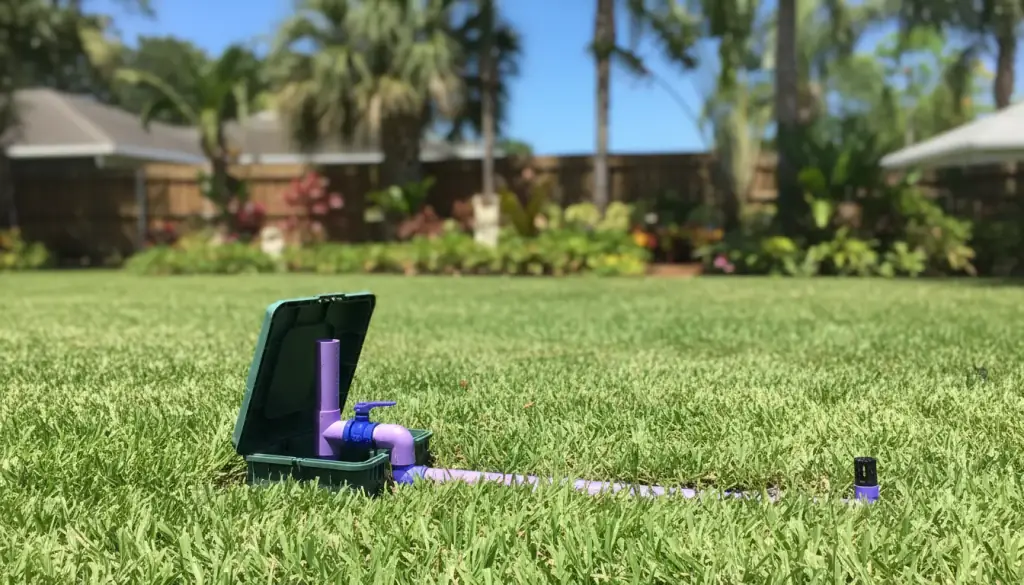
If you have seen a lilac coloured valve box lid on a neighbour's lawn and wondered what it was, that is a reclaimed water service. Brevard County runs a reuse network, and a property connected to it irrigates from treated wastewater rather than from the same supply that feeds the kitchen tap.
The number that matters
Customers on reuse save approximately 2,000 gallons of potable water a month. That is per property, per month, and it is the figure worth holding onto because it makes the rest of the argument concrete. A lawn is the single largest water consumer on most residential properties in this county, and all of that consumption is currently drinking quality water being sprayed onto grass.
For the county the arithmetic works in the other direction. Every property moved onto reuse is demand taken off potable and ground water, and water returned to the ground through irrigation is positive aquifer recharge rather than a straight withdrawal. On a barrier island with a lagoon on one side and a river on the other, that is not a theoretical benefit.
What it can feed
- Turf, plants and flower beds, which is most of what an irrigation system does anyway
- Fountains and ornamental ponds
- Any existing sprinkler or drip zone already in the ground, in most cases without rebuilding it
There is a side effect that surprises people: reclaimed water is not sterile, and it carries nutrient. Properties on reuse generally need less fertilizer than they did before. It does not replace a feeding programme but it does change the quantity, which is worth knowing before you order the year's supply.
What it cannot feed, and why the pipe is purple
Reclaimed water is not drinking water. It does not go to a hose bib you might fill a paddling pool from, it does not go anywhere near the potable plumbing of the house, and the two supplies are never cross connected. That is not a matter of preference. It is the whole basis on which a reuse network is allowed to exist.
Everything in the reclaimed system is colour coded lilac by convention: the pipe, the risers, the valve box lids, the shutoffs. The colour exists so that nobody digging in a yard in fifteen years, including a contractor who has never seen the property before, can mistake one line for the other. It is one of the few genuinely universal conventions in this trade.
What it costs to run against potable
Reuse is billed differently from drinking water, and in most Brevard service areas it is billed at a lower rate because the water has already been treated once and the utility would otherwise be disposing of it. The saving on a property with real lawn area is not marginal. What makes it worth pricing rather than assuming is that the connection itself is a one off cost, so the honest question is how many months of your current irrigation bill that cost represents.
There is also a watering schedule attached. Reuse availability is managed, and counties set days and hours for irrigation on the reclaimed network the same way they do for potable. A controller that can actually be programmed for those days is part of making the switch worth it, which is one reason a reuse connection and a controller replacement often end up on the same quote.
What the connection work involves
The change happens upstream of your zones. The city runs the reuse main, decides where a property can connect and what the connection has to look like, and there is an inspection involved. On the property side the supply is brought to the system, kept visibly separate from the potable plumbing, and the zones are fed from the new source.
Most existing irrigation stays. If there are already sprinkler heads and laterals in the ground that work, they generally keep working. Where the system needs attention it is usually for reasons that had nothing to do with reuse: heads that have settled, a controller nobody can programme, a valve that has been weeping for a year.
Who to have do it
This is the part of irrigation where the work has to satisfy somebody other than the homeowner. A contractor who treats the water department as paperwork is a contractor who will eventually hand you a connection that has to be dug up and done again.
Hartmann Irrigation works with and is referred by city water departments, and has done reuse connections in Central Brevard County for years. We are fully licensed and insured, IR 52. If your street has reuse available and you are wondering whether it is worth connecting, call (321) 454-3314 and we will come and look at what you have. The estimate is free.
Hartmann Irrigation Inc, (321) 454-3314
Call (321) 454-3314More articles
Why one corner of your lawn stays brown when the rest is fine
The most common irrigation call we get in Merritt Island has almost nothing to do with the pump.
Drip or spray: which one your planting beds actually want
Most properties end up with both. The question is which zones get which, and it is not a matter of taste.