Drip or spray: which one your planting beds actually want
Most properties end up with both. The question is which zones get which, and it is not a matter of taste.
September 17, 2026 · 4 min read
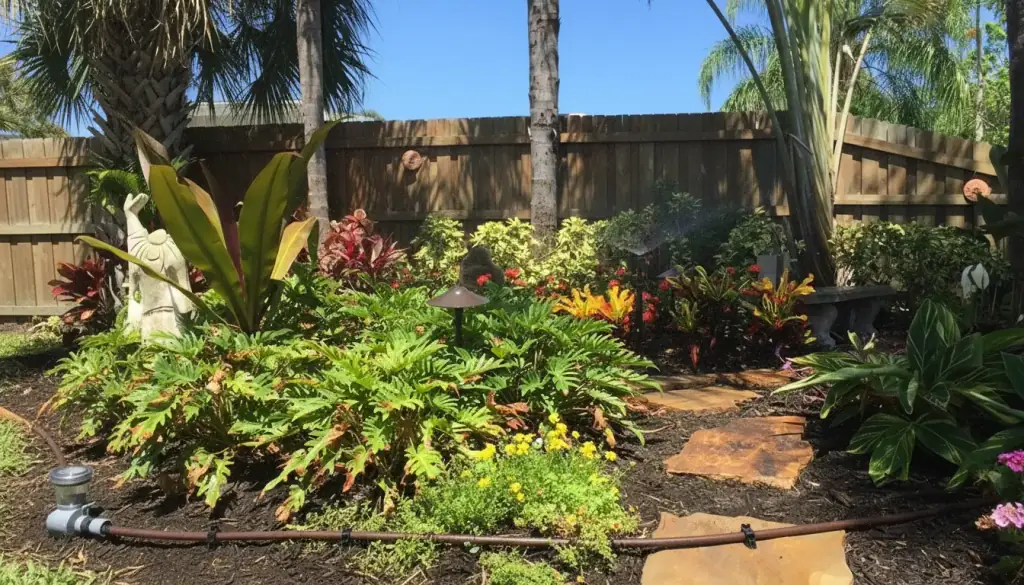
Almost every property we work on in Central Brevard County ends up with sprinkler zones and drip zones, split apart so the beds are not watered on the lawn's schedule. That split is worth understanding, because putting the wrong zone type on an area is one of the few irrigation mistakes that keeps costing money every month.
What drip is for
Drip suits planting beds, flower beds, crops, and anything with foliage that marks, spots or burns when it is sprayed in afternoon sun. It suits anything planted at intervals rather than as continuous ground cover, because water can be delivered to each plant instead of to the whole bed.
Spray suits open turf. Grass is continuous, it wants water across its whole area, and that is exactly what an arc of spray delivers. Trying to run turf on drip means an impractical amount of tubing and a lawn that is striped.
Where the water saving comes from
A drip system uses between 30 and 50 percent less water than conventional irrigation, and the mechanism is worth stating plainly rather than taking on faith. A spray head throws water into the air. A real share of that never reaches the ground at all, lost to evaporation and carried off by wind, and the finer the droplet the worse it is. An emitter releases water at the base of the plant, at soil level, slowly enough that the ground absorbs all of it.
There is a second saving that nobody puts on the brochure. A spray head waters everything inside its arc, including the bare mulch between your plants. Weed seed in that mulch gets watered on exactly the same schedule as the plants you are trying to grow. Drip waters the plants and leaves the gaps dry, and the difference in weeding is noticeable within a season.
The two parts that decide whether it lasts
An emitter is a very small hole, and that is the entire design problem with drip. Brevard water carries fine grit and mineral. Put it through unfiltered tubing and emitters start plugging within a season, usually the ones furthest down the run, so the far end of the bed browns off while the controller cheerfully reports that the zone is watering.
So every drip run should start with two things at the head: a filter, and a pressure regulator. The filter is obvious. The regulator is the part people skip, and it matters because drip runs at a far lower pressure than a spray zone. Mains pressure into poly tubing either pops fittings off or drives water out of the emitter faster than the soil can take it, which puts the water on the surface where it evaporates. Both parts are inexpensive. Neither is optional.
Reading a drip zone
Run the zone and look at the soil. A healthy drip run darkens the ground in an even band, and the shape of that band is the fastest diagnostic in irrigation. A dry section means a plugged emitter or a kink. One emitter running twice as fast as its neighbours usually means a split. A patch of mulch that never dries out between cycles means a failed emitter or too long a run time.
None of that is visible from the controller, which is why drip zones benefit from being looked at occasionally rather than simply being trusted.
Run times are different, and that catches people out
A drip zone delivers water far more slowly than a spray zone, so the run time that soaks a lawn will barely wet a bed. People who add drip to an existing controller frequently leave the drip zone on the lawn schedule, decide drip does not work, and go back to spray. Drip zones generally want longer, less frequent cycles, and they want to be judged by digging a finger into the soil rather than by looking at the surface, because the surface of mulch can be dry while the root zone underneath is holding plenty.
Maintenance is mostly the filter
Rinse the filter screen. Replace the emitters that have plugged. If several on one run go at once, the filter is telling you something rather than the emitters being faulty. Lift and re-pin tubing where the mulch has moved. That is genuinely most of it.
One more thing worth mentioning if you are planning ahead: drip pairs well with rainwater harvesting, because the flow rate a drip zone needs is small enough for a collection system to supply comfortably. If you are considering both, it is worth quoting them together.
Hartmann Irrigation designs, installs and maintains drip systems across Central Brevard County, licensed and insured, IR 52. Call (321) 454-3314 for a free estimate.
Hartmann Irrigation Inc, (321) 454-3314
Call (321) 454-3314More articles
Why one corner of your lawn stays brown when the rest is fine
The most common irrigation call we get in Merritt Island has almost nothing to do with the pump.
Going on reclaimed water in Brevard: what actually changes
The purple pipe is the visible part. The useful part is roughly 2,000 gallons of drinking water a month that stops going on your lawn.