Collection and storage
Rainwater harvesting sized to your roof and what you water
Professionally installed collection systems for residential and commercial property, matched to what the roof actually delivers and what the grounds actually need. Waters lawn, crops and plantings, and it comes off the municipal bill.
Chapter 01
Sizing it off the roof, not off a catalogue
Two numbers decide the size of a collection system: how much water the roof delivers in a typical Brevard month, and how much the zones you intend to feed actually draw. Get the first one right and the tank fills. Get the second one right and it is still holding water in the week you need it.
The mistake we see most often is a tank chosen because it looked like the right size in a picture. Undersized, it overflows in every summer storm and runs dry in the dry season, which is precisely the wrong way round. Oversized, it is money in a plastic cylinder that never fills, and on a lot of Central Brevard properties there simply is not the roof area to justify it.
In practice the honest answer for many properties is a modest collection feeding the beds and the drip zones, with the turf staying on the main system or on reclaimed water. That combination is usually what we end up quoting.
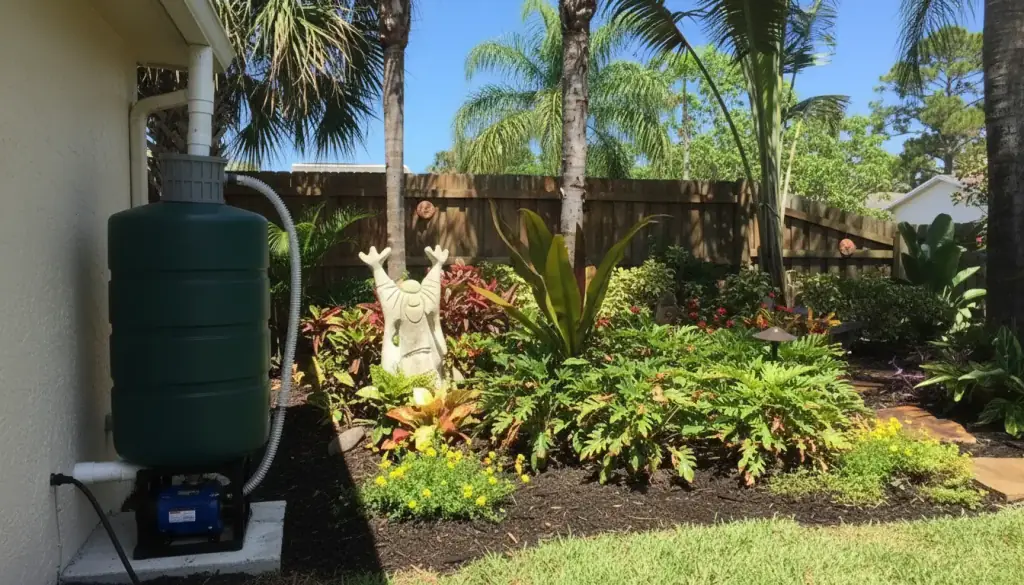
A rainwater harvesting cistern standing against a house wall beside a downspout diverter, inlet filter and overflow plumbed in, pump on the pad below
Inlet filtration and an overflow that was actually planned
Everything that lands on a roof goes down the downspout with the water: leaf litter, grit, whatever the last storm put up there. A collection system without inlet filtration becomes a tank of sediment, and that sediment ends up in whatever it feeds. Fine for a hose bib, fatal for a drip line, where the emitters are the smallest holes on the property.
So the inlet gets a filter and a first flush arrangement, and the tank gets an overflow that is plumbed rather than left to find its own way. That second part matters more than it sounds. An overflow that discharges at the base of the tank is an overflow that puts storm water against the slab of the house it is standing next to, every time the tank fills.
The pump sits on the pad at the base and is sized to the zones it feeds, which for drip is a genuinely small pump. Collection systems paired with drip zones are the easiest version of this to make work, because the flow rate a drip run needs is well inside what a cistern can deliver.
Chapter 03
What it offsets, and what it does not
A working collection system waters lawn, crops and plantings off water you have already paid for once, and it shows up on the municipal bill rather than in a brochure. On a commercial property with real roof area the arithmetic gets more interesting than it does on a house.
It is irrigation water. We do not plumb collection into a potable supply and would not quote it, for the same reason the reclaimed work is kept visibly separate: the two supplies never meet.
Hartmann Irrigation has been installing and servicing irrigation out of Merritt Island since 1980, licensed and insured, IR 52, and the estimate on a collection system is free like everything else. Call (321) 454-3314 and we will come and measure the roof.
Hartmann Irrigation, Merritt Island since 1980. Licensed and insured, IR 52. Call (321) 454-3314.