Beds, crops, plantings
Drip irrigation, designed around where the water is actually needed
Complete design, installation and maintenance for beds, crops and plantings. A drip system uses 30 to 50 percent less water than conventional irrigation, because none of it is thrown through the air.
Chapter 01
Where drip beats spray, and where it does not
Drip is the right answer for planting beds, flower beds, crops and anything with foliage that marks or burns when it is sprayed in the afternoon sun. It is generally the wrong answer for open turf, which is what sprinkler zones are for. Most of the properties we work on in Central Brevard County end up with both, split into separate zones so the beds are not asked to drink on the lawn's schedule.
The mechanism is simple enough to check yourself. A spray head throws water into the air and a real share of it never arrives, lost to evaporation and to wind before it lands. An emitter releases water at the base of the plant, at the root, at a rate slow enough that the soil takes all of it. That is where the 30 to 50 percent saving comes from, and it is a distribution figure rather than a promise.
There is a second effect that customers notice before the water bill does. Water goes to the plants and not to the gaps between them, so the weeds that used to come up in the open mulch stop being watered.
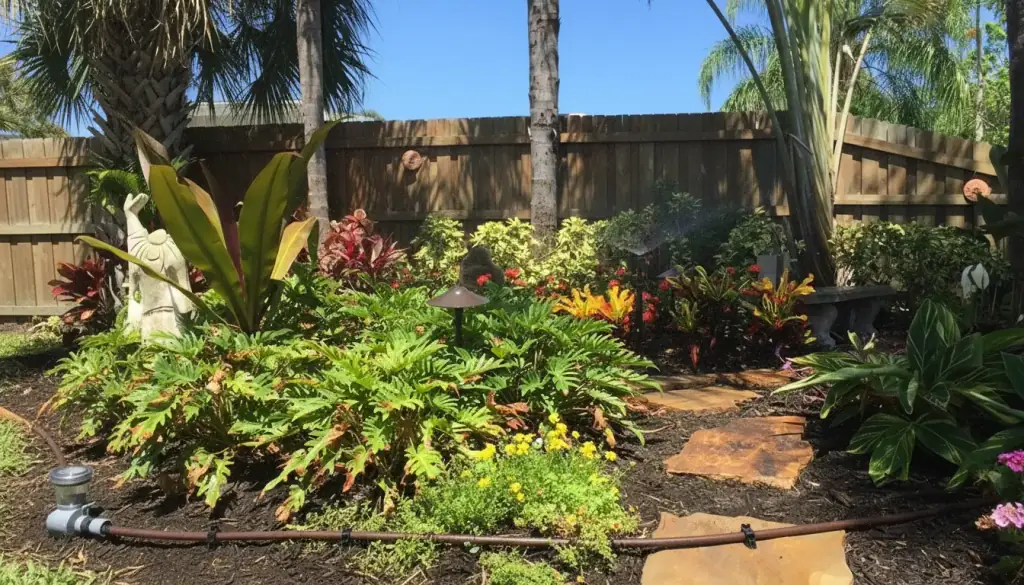
Drip tubing pinned along the edge of a mulched planting bed, emitters set at the base of the plants and the ground darkening under each one
Filter and regulator at the head of every run
An emitter is a very small hole, and that is the whole design problem. Brevard water carries fine grit and mineral, and an unfiltered drip line will start plugging emitters within a season, usually the ones furthest down the run. The bed then browns off at one end while the timer insists the zone is watering.
So every run we install starts with a filter and a pressure regulator assembled at the head. Drip runs at a far lower pressure than a spray zone, and putting mains pressure into poly tubing either blows fittings off or drives water through the emitter so fast the soil cannot take it. Both of those are avoidable with two parts that cost very little.
The tubing itself is pinned along the bed edge and worked in under the mulch rather than buried, so it can be lifted, checked and extended when the planting changes. Beds are not static and the irrigation should not be either.
Chapter 03
What maintenance actually involves
Once a drip system is in, the ongoing work is mostly the filter and the emitters. The filter screen comes out and gets rinsed. Emitters that have started to plug get replaced, and if several on one run have gone at once that is usually telling us something about the filter rather than about the emitters.
We also check the wet pattern. A drip zone should darken the soil in an even band along the run, and the shape of that band is the fastest diagnostic there is. A dry section, an emitter running twice as fast as the ones either side of it, a soft spot in the mulch that never dries out, all of those are visible in a minute and none of them show up on a controller.
Rainwater harvesting pairs naturally with drip, because a drip zone's low flow rate is well within what a collection system can supply. If you are already thinking about one, it is worth quoting both together.
Hartmann Irrigation, Merritt Island since 1980. Licensed and insured, IR 52. Call (321) 454-3314.