When a sprinkler pump needs rebuilding and when it needs replacing
A station that behaves badly is not automatically a station that has to be replaced, and the difference is usually on the suction side.
September 17, 2026 · 4 min read
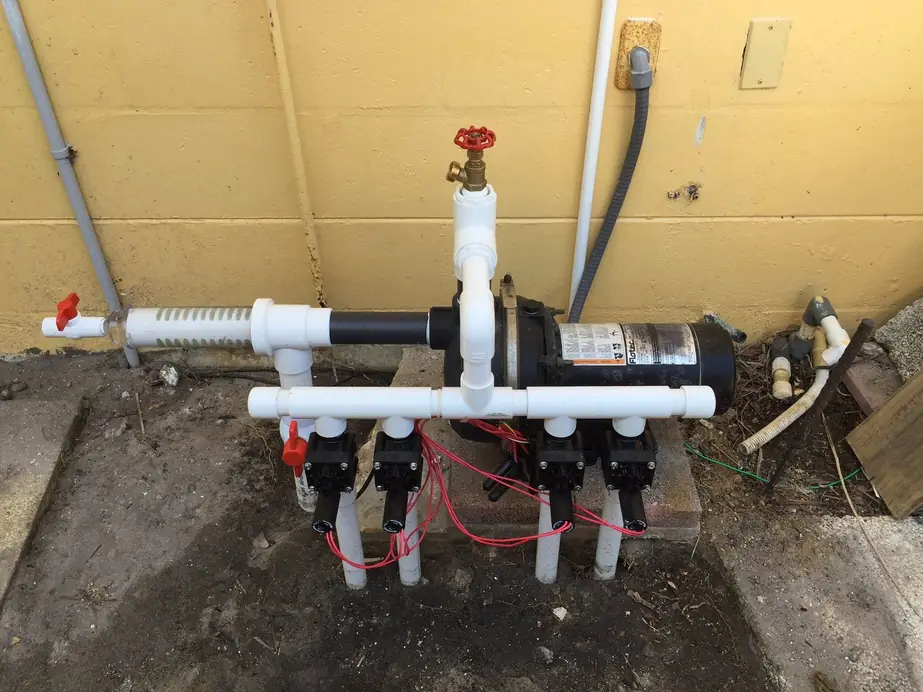
Irrigation pumps tend to fail in ways that look worse than they are. The system loses prime. The pump starts, runs for thirty seconds and stops. Pressure surges and drops while a zone is running. Every one of those symptoms is alarming, and every one of them is produced as readily by a cracked fitting as by a dying pump.
Check the suction side first
A centrifugal pump moves water. It cannot move air. If air is getting into the line ahead of the pump, the pump will behave exactly like a failing pump while being in perfect condition, and that is the single most common finding on an irrigation pump call.
- A cracked fitting or a dried out union on the suction line, which can be small enough to be invisible while wet
- A strainer housing that has not been opened in years, packed enough to starve the pump
- A foot valve or check valve that is no longer holding, so the line drains back between cycles and the pump has to reprime every time
- A suction line sitting too high, or a water level that has dropped below where the system was designed for
Those are cheap problems. They are also the reason it is worth having somebody look at a station before agreeing to replace it.
What cannot economically be rebuilt
A motor that has been run dry is usually finished. Running without water removes the only cooling and lubrication the seal has, and once the seal faces are damaged, water gets where the bearings are. A pump body that has lost its seal faces is in the same category. Those are replacement conversations.
Almost everything else on a station can be renewed independently: the strainer, the shutoff, the discharge plumbing, the valve manifold, the wiring, the controller. On a station that is otherwise sound, renewing those parts puts a property back in service for a fraction of what a new station costs.
Why a bigger pump is usually the wrong answer
When a replacement is genuinely needed, the instinct is to fit something with more capacity than the old one on the theory that more pressure means better coverage. It does not. Sprinkler nozzles are designed to produce a particular droplet size at a particular pressure. Push more pressure through them and the spray atomises into a finer mist, and fine mist is exactly what evaporates and blows away before it lands.
The result is a system that uses more electricity and more water while covering the far corner of the property less well than it did before. A pump should be sized to the zone with the highest demand, not to the largest motor that will fit on the pad.
Controls are part of the job
A station without working controls runs when somebody remembers, which in practice means far too long in the wet season and not at all in the week it matters. New timer and controls belong in any rebuild, wired so each zone switches separately and the low voltage is dressed clear of the valve bodies.
That last detail sounds trivial and is not. A pinched or chewed common wire is the most frequent reason an entire system goes silent at once, and it is nearly always the result of wiring run across the top of a manifold where it gets stood on and strimmed.
What a rebuild looks like on the day
The station comes apart on the suction side first, because that is where the diagnosis usually lands. Strainer housing out and cleaned or replaced, suction plumbing renewed where it has gone brittle, the shutoff checked or swapped. Then the pump end gets its seal and its impeller looked at, and the discharge side and manifold are rebuilt as needed. The wiring is redone and dressed, and the controller goes on last so the zones can be tested one at a time before anybody leaves.
It is a day of work on most residential stations, and the property is generally irrigating again the same evening. The reason to keep the old pad and plumbing where it is sound is not sentiment. It is that every joint you do not disturb is a joint that cannot leak next year.
One more thing a station can do
On flat, low lying Brevard lots a pumping station is not only there to push water at sprinkler heads. It can collect settled water off low areas and move it somewhere useful, which on a property that ponds after every summer storm may be worth more than the irrigation itself. The same station combines with whatever irrigation is already in the ground.
Hartmann Irrigation rebuilds and installs pumping stations for potable water, irrigation, boosting and water reuse across Central Brevard County, and is referred by city water departments. Licensed and insured, IR 52. Call (321) 454-3314.
Hartmann Irrigation Inc, (321) 454-3314
Call (321) 454-3314More articles
Why one corner of your lawn stays brown when the rest is fine
The most common irrigation call we get in Merritt Island has almost nothing to do with the pump.
Going on reclaimed water in Brevard: what actually changes
The purple pipe is the visible part. The useful part is roughly 2,000 gallons of drinking water a month that stops going on your lawn.