Five irrigation questions worth asking before you buy a Florida house
An irrigation system is rarely inspected and never cheap to put right. These five questions take ten minutes.
September 17, 2026 · 4 min read
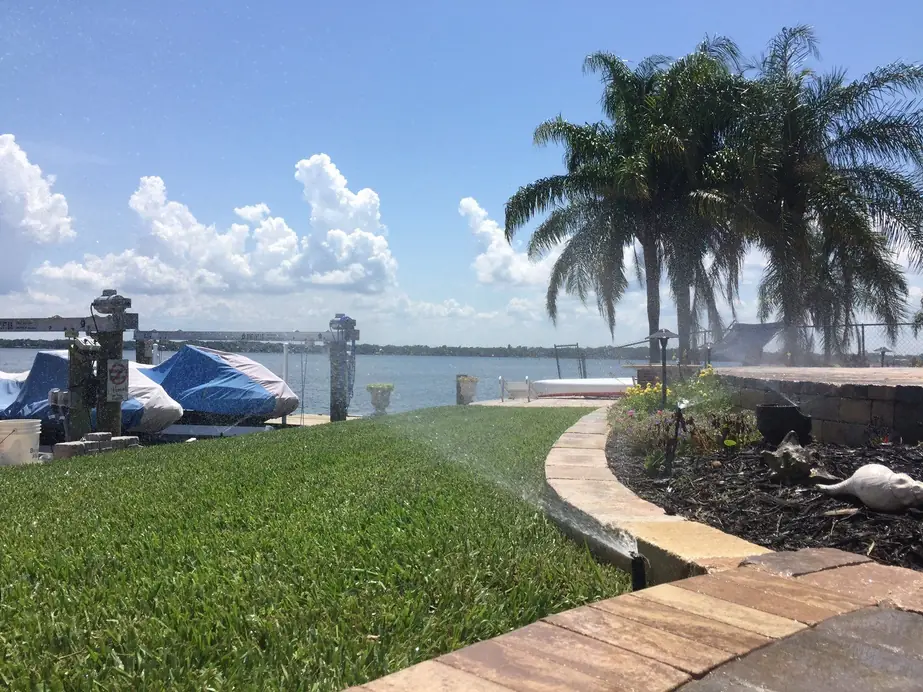
Home inspections in Florida look hard at the roof, the air conditioning and the plumbing inside the walls. Irrigation usually gets a line saying a system is present. Whether it works, what it is connected to, and what it will cost to bring back are questions almost nobody asks before closing, and the answers can run into real money.
One: what supply is it on?
There are three possibilities in Brevard County, and they have very different running costs. The system may be on potable water, which is the most expensive way to irrigate. It may be on a well, which has its own maintenance and its own iron staining issues. Or it may be on the city reclaimed line, which is the cheapest and is the reason you might see lilac coloured valve box lids in the yard.
If it is on potable and reuse is available in the street, that is a change worth pricing. Customers on reuse save approximately 2,000 gallons of potable water a month.
Two: can somebody run every zone in front of you?
Ask for every zone to be run in turn while you stand outside and watch. This takes about ten minutes on a typical property and it answers more questions than any document. You are looking for heads that do not pop up, heads pointing at the driveway, a zone that does not come on at all, and any part of the lawn no water reaches.
A seller who cannot run the zones, because nobody knows the controller or it has not worked in years, has told you something useful.
Three: where is the pump, and what does it sound like?
Find the pump and listen to it start. A station that primes and settles into a steady note is a station in reasonable health. One that starts, runs briefly and stops, or that surges while a zone is running, usually has air getting in on the suction side. That may be a cheap fix and may not be, but you want to know it exists.
Four: what is actually planted, and is it zoned for that?
Open turf wants spray. Planting beds, and especially anything with foliage that burns in afternoon sun, want drip. Plenty of Florida properties have a mature landscape sitting on zones that were laid out for grass, which is why the beds look tired while the lawn is fine.
It is fixable, and splitting beds onto their own drip zones usually reduces the water bill rather than adding to it. Just price it before you plan the garden.
Five: when was anything last done to it?
Ask whether the system has been serviced, and by whom. Irrigation drifts out of its design slowly: a head settles half an inch, a nozzle wears, a mower knocks an arc round, a shrub grows into the spray. None of that shows up on any single day, and all of it accumulates. A system that has been checked annually will need very little. One that has not been touched in a decade is a small project.
A sixth, if the house has been empty
Vacant Florida houses are hard on irrigation in a specific way. If the system has been off for months, seals dry out, valve diaphragms stiffen, and the first time somebody runs every zone in sequence two or three of them will weep or fail to close. That is not a sign the system is finished. It is the normal consequence of an irrigation system sitting dry in heat, and it is worth expecting rather than discovering after closing.
The same applies to the pump. A station that has not run since spring may need priming and may take a few minutes to settle. Judge it after it has been running, not in the first thirty seconds.
What a system is roughly worth putting right
Rough categories, because every property is different. Nozzle and head work across a whole system, resetting arcs and swapping worn parts, is the cheapest outcome and the most common one. A controller replacement and rewiring is a step up. A pump rebuild is a day of work. A full system replacement on a large property, or a reuse connection, is a project you would plan rather than absorb. Knowing which category you are in before you close is the entire point of asking.
What it is worth knowing beforehand
None of these questions requires expertise to ask, and between them they distinguish a system that needs a service call from a system that needs replacing, which is a difference of thousands of dollars. It is worth ten minutes in the yard before you close rather than a surprise in your first dry season.
If you have just bought somewhere in Central Brevard County and want to know what you have inherited, Hartmann Irrigation has been working in this county since 1980, is licensed and insured, IR 52, and the estimate is free. Call (321) 454-3314.
Hartmann Irrigation Inc, (321) 454-3314
Call (321) 454-3314More articles
Why one corner of your lawn stays brown when the rest is fine
The most common irrigation call we get in Merritt Island has almost nothing to do with the pump.
Going on reclaimed water in Brevard: what actually changes
The purple pipe is the visible part. The useful part is roughly 2,000 gallons of drinking water a month that stops going on your lawn.